Client records
One place for every client, lead and session, instead of a spreadsheet that became four spreadsheets with nothing in the middle.
What you end up with. A CRM of your own, behind a login, holding the people you work with and what happens next with each of them.
cheap crm for a one person business
What people walked out with
- Every client, lead and session in one place
- A next action with a date on it
- Where each one came from
- Clients shared with a colleague, and clients who are yours
- Two way calendar, both directions
- Behind a login that emails you a code
- No fee per user, per month, forever
-
Mate helped me save hours of work by showing me how to prompt it myself. Suzanne Fay
Every business starts with a spreadsheet. It works until the day somebody sends you ten enquiries in one go, and then it is four spreadsheets with nothing in the middle of them.
A CRM is the unglamorous answer: contacts, where each one came from, and what happens next. The interesting part is that it is now a thing you can have built for your own practice rather than rented in a shape somebody else chose.
What comes out of a session
A psychologist arrived with hers already built, having asked her agent for it between sessions, and spent the time on the shape rather than the code: contacts that can be a lead or a client, where each one came from, clients shared with a co-therapist and clients who are hers alone, a next action with a date instead of a reminder system, and a two way calendar link so a booking made on her own site turns up in both places. By the end her real bookings were showing in her own CRM, behind a login that emails her a one time code.
What it costs
The hosting, and nothing recurring for the software. This is the category where the rented version is priced per user per month forever, for a shape that never quite matches how you actually work.
What goes wrong
Never tell it to use a spreadsheet as the store. It will agree, and you will have rebuilt the problem you came to solve.
Ask for the whole thing at once, not one field at a time. Described in pieces, it builds you a piece. Described whole, it can plan, and planning is the part you want it doing.
It will quietly drop half of what you asked for. The fix is to keep your own list and read it back at the end, out loud, against what exists. That happened on the show and it is on the tape.
A small practice does not have to scale. An architecture built for thousands of users is layers you will maintain forever for a business with one of you in it. Ask it what it would remove.
The measurement worth taking
Count how many separate places a client’s name currently lives: the calendar, the inbox, the spreadsheet, the invoice, the notes. That number is what this replaces, and it is the number that makes the case on its own.
Sessions on this
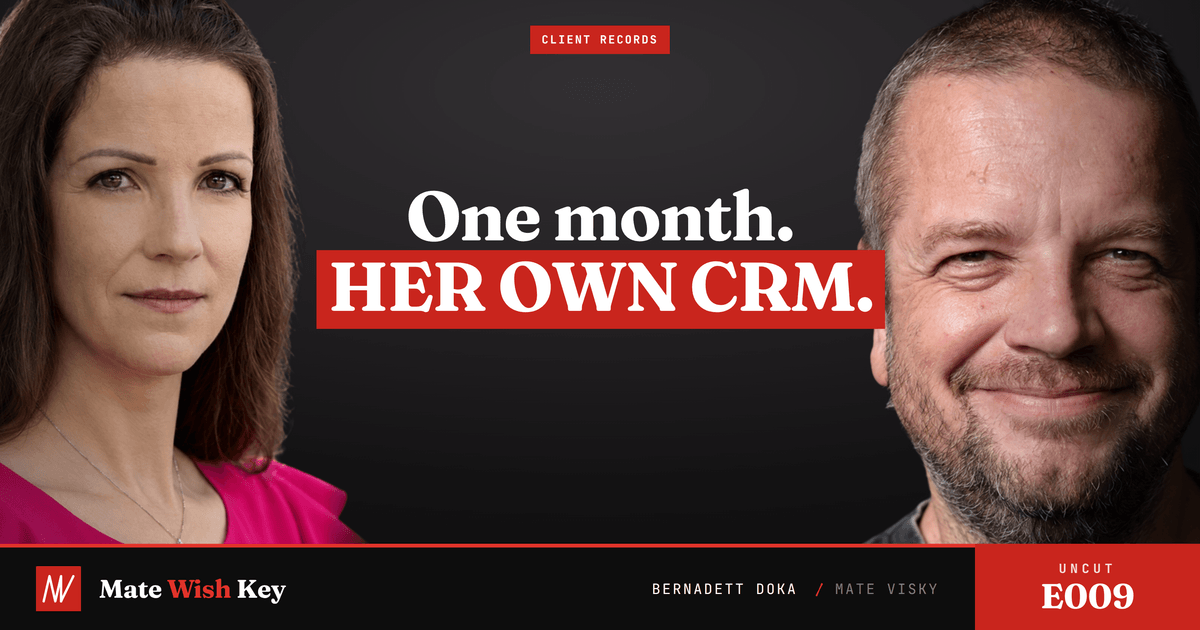
One month. Her own CRM.
with  Bernadett Doka
More topics
- Accounting integration Connecting the tools you already pay for, so the same figures stop being typed at both ends.
- Lead generation Finding out who might actually buy from you, and building the list yourself instead of renting it.
- File movement integration Documents filing themselves, between the storage services you already use, without a subscription in the middle.