One month. Her own CRM.
A place to keep every client, lead and session, so ten emails from a referral centre do not become forty she cannot remember.
What came out of it. She arrived with it already built. Her first client had been and was coming back, a referral centre was emailing her leads in a fixed format, and the spreadsheet she started with had turned into too many workbooks with nothing in the middle. So she had asked her agent for a CRM, and it had given her one, behind a login that emails her a one-time code. The session was spent on the shape rather than the build: contacts that can be a lead or a client, where each one came from, clients shared with a co-therapist and clients who are hers alone, a next action with a date instead of a reminder system, and two way Google Calendar so a booking made on her site turns up in both. By the end her real bookings were showing in her own CRM. The last thing the agent did was forget half the requirement list, which is on the tape too.
The session
The full session · 2h 33m · Watch on YouTube
No prompt log for this session.

The hero of this one
Bernadett Doka
Psychologist · Grief Method Specialist · couple and family therapist in training
The first guest on the show, and the one who kept coming back. Four sessions, from never having opened a terminal to running her own CRM.
Worth stealing
Give it the whole list in one go, then ask what you missed
Not one requirement at a time. Everything you can think of, then "research similar systems and tell me what is missing", then let it design. A system built from a drip feed has no shape, and you only find that out months later.
Do not name the technology in the wish
"Build it in a spreadsheet" is a rigid system it now has to obey. Say what you need and let it choose. She had already moved off spreadsheets herself, for the reason she gave: too many sheets, and nothing in the middle.
Memory is per folder, so one project per folder
Six of her nine projects had none, and what she had explained in the website folder was simply not known in the CRM folder. Starting a project inside another project's folder is where that begins.
Ask it what you are doing wrong
"Review the last two weeks of chat history and point out what I am doing wrongly and what we are misunderstanding, so I can be a better prompter." Worth running every week or two, and it is the only review of your own habits you will get.
Functionality first, design when you know what you need
Take the plain version, collect the annoyances for a few weeks, then have one redesign session. Deciding the layout on day one means deciding it before you know what the thing does.
Tell it you are small
"This system does not have to scale. I want to spend less time on administration and more time listening." That sentence removes half of what a CRM template would otherwise build, and none of it was ever going to be used.
What happened, when
Every line opens the session at that moment.
- 0:00 Third time back, and her first client
- 1:13 Ten emails from the centre, and forty she will not remember
- 3:00 What she needs to know when she starts the day
- 4:13 The ones who never answered, and the ones coming in November
- 4:52 What a CRM is, sketched out on paper
- 5:30 Contacts, leads, and where each one came from
- 5:39 Shared clients, because family therapy has two therapists
- 8:14 Reminders, or a next action with a date
- 11:07 "Do you want to look at what is already built?"
- 11:19 She had already built it, off the spreadsheets
- 11:33 Why you never tell it to use a spreadsheet
- 14:45 A login that emails her a one time code
- 15:50 A project inside another project, which is never the practice
- 21:04 What was still missing from her own list
- 21:45 Everything in one go, not one thing at a time
- 27:21 Reading the emails: the chat window or the server
- 30:56 A small practice does not have to scale
- 33:16 Keeping the invoice split between two therapists
- 35:08 Asking it what she is doing wrong as a prompter
- 38:05 Too many layers, and the architecture review
- 45:21 What to skip: no client portal, no billing rebuild
- 46:33 Memory is per folder, and six projects had none
- 57:27 The review comes back: it planned first, and sketched first
- 1:00:40 There was never a Google integration at all
- 1:08:42 Two way calendar, done properly
- 1:17:20 A Google Cloud project, and what it actually costs
- 1:23:34 The credentials file, downloaded and handed over
- 1:29:33 The integration works
- 1:32:08 Three design iterations, and picking the plain one
- 1:38:40 Functionality first, design when you know what you need
- 1:42:51 One month ago she was on holiday
- 2:17:08 Illustrations, generated for a client session
- 2:29:20 Her real bookings show up in her own CRM
- 2:31:12 What it forgot, and a very bad robot
Show notes
Her third session, and she came in with it already made. A referral centre had started emailing her clients in a fixed format, ten of them so far, forwarded from her old address to her practice one. Ten she can hold in her head. Forty, in two months, she cannot, and she said so in the first two minutes. She had started in a spreadsheet, watched it turn into too many workbooks with nothing in the middle, and asked her agent for something better instead.
So the evening was about the shape of it rather than the making of it. A contact that can be a lead or a client and remembers where it came from. Clients shared with a co-therapist, and clients who are hers alone, because family therapy has two people billing. A next action with a date, which is what a reminder is once you stop calling it one. Then Google Calendar, both ways, so a booking made on her site appears in her CRM and a session in her CRM blocks the slot on her site. By the end her real bookings were in there.
The last thing on the tape is the agent being told it had forgotten half the requirement list and asked to explain why. That is in the recording too, because it is the part that happens to everybody.
Last updated 15 September 2026. Published as-is: read what a prompt does before you run it. The disclaimer has the rest.
Also with Bernadett Doka
-
 5 August 2026 · 1h 31m First terminal. Agent running. A Mac set up from nothing: the terminal opened for the first time, an agent installed on it, and her own website checked out onto her own machine.
 -
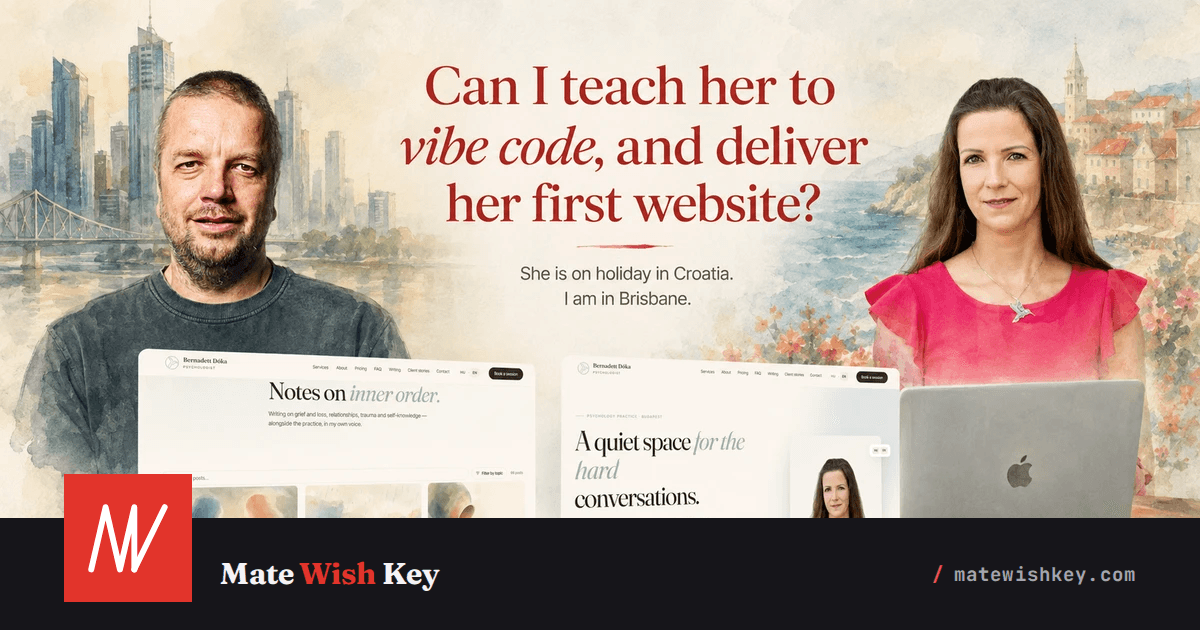 7 August 2026 · 2h 11m Her site. She owns it. A bilingual site she owns and can change herself: her services, a way to book her, and somewhere to put her writing.
 -
 3 September 2026 · 1h 46m Psychologist. Surveys. Done. Everything she made alone in the month between sessions, reviewed: the surveys, who opened them, and what has to be true before a real client fills one in.